
This article is written for dentists and should not be read as patient information or a treatment recommendation. It is a literature-based clinical guide by Dr. Ferit Çiftçi and has not been peer reviewed. References and a methods note are at the end.
CLINICAL GUIDE · COMPOSITES AND ADHESION
Shade selection for anterior composites: dehydration, lighting and the trial button
CLINICAL SUMMARY
For an anterior composite, record the shade as soon as the lips are retracted and the tooth is exposed to air, before isolation. In 452 upper incisors the colour difference passed the perceptibility threshold at minute 2 and the acceptability threshold at minute 6;1 in another study the change became perceptible within the first minute.6 A shade tab does not show the colour a composite will give on the tooth, and composite colour changes on polymerisation, so the first choice is tested with a small trial button placed on the tooth and cured.2, 3 The colour match of the restoration is judged after the tooth has rehydrated, at a review visit.4
Why does tooth colour lighten within minutes?
Colour differences in this article are read against two thresholds: ΔE00 0.8 for perceptibility and ΔE00 1.8 for acceptability. In Paravina's multicentre study, half of 175 observers noticed the first difference and half judged the second unacceptable; the measurements used ceramic specimens under simulated clinical conditions.5
Drying starts when the lips are retracted and the tooth is exposed to air, and the tooth gets lighter as it dries. When Ruiz-López's group measured 452 upper incisors in 113 participants every two minutes, L* and the whiteness index rose, while a*, b*, chroma and hue angle tended to fall. ΔE00 passed the perceptibility threshold at minute 2 and the acceptability threshold at minute 6, and at minute 2 more than half of the teeth were above the first threshold. The authors advise selecting the shade within the first two minutes of any procedure that risks drying the tooth.1
When the threshold is crossed varies from study to study. In Suliman's 32 participants the change became perceptible within the first minute after isolation; at the end of that minute 87% of teeth were above the perceptibility threshold and 72% above the acceptability threshold. This group advises selecting the shade within the first minute and before isolation.6 In Haciali's measurements with a clinical spectrophotometer, the difference was imperceptible up to minute 3, perceptible but acceptable at minute 5, and unacceptable at minute 15.24 In Burki's randomised trial, the central incisor dried under rubber dam came out significantly lighter than the other central incisor, left as control; the difference was found both with a spectrophotometer and by ten examiners looking at photographs.7
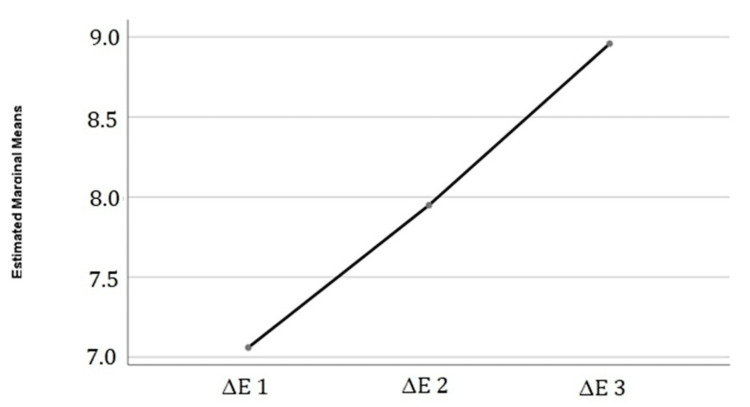
Rehydration is much slower than drying. In Suliman's patients, 65% of teeth were still above the acceptability threshold after 15 minutes of rehydration;6 in Burki's trial the difference persisted after 30 minutes.7 Of the teeth Hatırlı dried for 30 minutes, 85% had passed the acceptability threshold. After 30 minutes of rehydration the proportion fell to 31.6%; after 24 hours, 99.2% of teeth were below the acceptability threshold and 90% of values below the perceptibility threshold.4 In Haciali's measurements, 70% of teeth were below 0.8 at 24 hours, and the authors write that after 15 minutes of drying the colour may not fully return even after 24 hours.24 In Sharmila's study comparing younger, middle-aged and older groups, the change was smaller in older participants. After 24 hours, mean values in all groups were below the acceptability threshold; in most tooth groups it took 48 hours for them to fall below the perceptibility threshold.9
Light and viewing conditions
The conditions and method of clinical shade matching are rarely controlled, as Paravina and colleagues note in their review of thresholds.10 Wee's group measured ambient light in 32 private practices. Mean colour temperature was 4152.9 K, significantly different from the 5500 K standard, and the mean colour rendering index (CRI) stayed below the standard of 90. The light in most of these practices was not suitable for visual shade matching.11
Changing the light source changed the students' results. In a cross-sectional study of 102 students, scores with a handheld colour-correcting light were significantly higher than those under the clinic's fluorescent light.12 In a randomised laboratory study of 96 students, handheld lights scored higher than a viewing booth, and adding a polarising filter to the handheld light made no difference. Education and training also raised scores: the mean went from 6.8 in the pre-training sessions with the booth to 8.0 in the post-training sessions with handheld lights.13
Light does not affect every observer in the same way. In a study of 14 students and 14 dentists, the light source affected the results of those with poor colour discrimination and of the students, but not of those with superior or average discrimination.14 The technical report ISO/TR 28642:2016 covers visual and instrumental methods of colour assessment, interpretation of findings through colour difference thresholds, and guidance on the colour vision of people who carry out visual colour assessment.15
Shade tab or trial button?
When Melara and colleagues compared five shades of four composites in the laboratory with the corresponding tabs of a classical shade guide using a spectrophotometer, the colour difference for every shade was above 3.7 ΔE, the limit the study treated as clinically detectable; no composite shade matched the guide.2 According to Lee's review, the colour range of shade tabs differs from that of natural teeth, and materials with the same shade name differ in colour by type and brand.16 Paolone's group lists the limits of ready-made composite shade guides: specimen thickness is unrealistic, the guide is not made of the material the clinician will use, and few allow an enamel tab to be laid over a dentin tab. The same paper reports that small changes in enamel composite thickness can make large differences in the aesthetic result.17
All four composites Pedrosa tested showed significant colour change after curing and after 30 days in water; the authors state that the finding supports curing a small amount of composite on the tooth surface to select the shade.3 Curing time matters as well: in two composites the colour changed to a clinically significant degree at each step, from 10 to 20 seconds and from 20 to 30 seconds. The authors point out that under-cured and over-cured samples differed markedly from normally cured ones.18 In Ozturk's clinical study on the upper central incisors of 32 people, enamel and dentin composite were temporarily attached to the tooth with the button technique and photographed. Agreement between observers was good only when photographs were evaluated and poor with the other methods.19
Determining the shade from a photograph or with an instrument is a separate route. In a meta-analysis of 13 randomised and laboratory studies, selection with digital photographs and spectrophotometers gave smaller colour differences and fewer incorrect matches than shade tabs; in subgroup analysis only digital photographs reduced the colour difference.20 A review of 249 articles, by contrast, reports spectrophotometers as the method with the highest accuracy and precision, provided the clinical setting is controlled.21 For colour assessment from photographs, techniques using a cross-polarising filter agreed very closely with a clinical spectrophotometer, and Haciali's group considered the filter essential.24
When is the shade chosen?
-
CORRECT
The shade is recorded as soon as the tooth is exposed and before isolation, against the moist tooth.
-
INCORRECT
After isolation and etching the tooth dries and gets lighter. A shade matched to it ends up too light, and the restoration stands out once the tooth rehydrates.
Step-by-step protocol
Prepare the light in advance
Use a handheld colour-correcting light,13 or confirm that ambient light reaches about 5500 K colour temperature and a colour rendering index (CRI) above 90. Most practices Wee measured fell short of these values.11
Take the first record in the first minute
Once the lips are retracted, and before isolation, etching or long preparation, choose the starting shade with a shade tab and photograph the tooth.6, 1 A tab name does not show the colour the composite will give; this record is only a starting point.2, 16
Cure a trial button
Cure a small piece of the chosen composite on the tooth surface, with the same curing time and light you will use for the restoration; polymerisation changes the colour, and colour changed with curing time.3, 18 Since small differences in enamel thickness can change the result, it is reasonable to make the button about as thick as the planned layer; this is an inference from the finding, not the source's recommendation.17
Decide against the first record
Placing and curing the button does not fit into the first minute, and the tooth keeps drying meanwhile.1, 6 Look at the button under the same light, but do not move to a lighter shade because of how the tooth looks at that moment; decide against the first-minute record.
Photograph with a cross-polarising filter
For colour assessment from photographs, filtered techniques agreed very closely with a clinical spectrophotometer.24 In photographs taken with the button on the tooth, agreement between observers was good.19 The finding that a polarising filter made no difference applies to visual matching with a handheld light.13
Then isolate
Record the shade, remove the button and isolate. Do not reselect during the procedure; a dried tooth does not regain its colour within minutes (dehydration section).6, 7, 4
Colour match after the restoration
The colour seen at the end of the visit is misleading, because the neighbouring teeth are still dry. In Hatırlı's data, reliable assessment was possible only after 24 hours of rehydration.4 In Hashir's randomised clinical trial on 40 upper incisors in 30 patients, tooth colour was measured before isolation and restoration colour 10 minutes after curing, and both changed from baseline at every recall. At 28 days the mean difference between tooth and restoration was ΔE 3.5 and 3.6 in the two composite groups. The authors judged this acceptable against the older ΔE 3.7 threshold they used; against the 2015 threshold used in this article (ΔE*ab 2.7; ΔE00 1.8), these values are above the acceptable limit.22, 5
-
The restoration looks different from the neighbouring teeth. When do you see it?
- AT THE END OF THE VISIT
- AT REVIEW
Score the colour match
Use the revised FDI criteria; the score links to monitoring, refurbishment, repair or replacement.23
At review, colour match is one of the categories in the aesthetic domain of the revised FDI criteria. Scores are linked to reviewing and monitoring (1-4), refurbishment (3), repair (4) and replacement (5).23 For surface and margin assessment, see the note on finishing and polishing.
Common errors and fixes
| Error | Fix |
|---|---|
| Choosing the shade after isolation or etching. | Take the record as soon as the tooth is exposed, while it is moist.6, 1 |
| Having the patient rinse once the tooth has dried and reselecting a few minutes later. | Rinsing does not bring the colour back within minutes (dehydration section).6 Go back to the record taken before the procedure. |
| Choosing the composite by the tab name. | Composites did not match the shade tabs they corresponded to within acceptable limits;2 confirm the choice with a trial button of that composite. |
| Judging the trial button uncured, or cured for a different time. | Compare the button after curing it with the time and light you will use for the restoration.3, 18 |
| Choosing the shade under the clinic's fluorescent light. | Switch to a handheld colour-correcting light,12 or confirm that ambient light reaches about 5500 K and a CRI above 90.11 |
| Judging the shade from a photograph taken without a filter. | Use a cross-polarising filter for colour assessment from photographs.24 |
| Correcting a shade that looks different at finishing in the same visit. | Leave the assessment to a review visit, after the tooth has rehydrated.4 |
Level of evidence
What is known
In vivo measurements by different groups consistently show that a drying tooth gets lighter.1, 6, 7, 4, 24 When the threshold is crossed is not consistent: the perceptibility threshold was passed within the first minute after isolation in one study,6 at minute 2 in another,1 and between minutes 3 and 5 in a third, where the acceptability threshold was passed at minute 15.24 In none of these studies did 15 to 30 minutes of rehydration complete the return.6, 7, 4, 24 Laboratory studies have shown that composites do not match their corresponding shade tabs and that they change colour on polymerisation.2, 3 Studies with students have shown that lighting and training affect visual selection.12, 13
What is not known
These sources mostly measure change in tooth colour. This search found no clinical study comparing the colour match of restorations whose shade was chosen on dried versus moist teeth. Nor did it find a comparative clinical study showing that checking with a trial button improves the final colour match; the advice rests on laboratory data on colour change during polymerisation3 and on one clinical study of observer agreement.19 No study was found on how to keep the tooth moist while the button is placed and cured. Most lighting studies were done with students and shade tabs.12, 13, 14 Findings on digital methods are not consistent: in the meta-analysis the spectrophotometer showed no advantage over shade tabs for colour difference, while a review reports it as the most accurate method.20, 21 The thresholds were set with ceramic specimens,5 and studies use different instruments and formulas; in the same study the acceptability threshold was passed at minute 6 with ΔE00 and at minute 8 with ΔE*ab.1 No success rate can be derived from these sources.
At the chair
References
- Ruiz-López J, Pulgar R, Lucena C, Pelaez-Cruz P, Cardona JC, Perez MM, et al. Impact of short-term dental dehydration on in-vivo dental color and whiteness. J Dent. 2021;105:103560. PMID: 33352224 · DOI: 10.1016/j.jdent.2020.103560 IN VIVO
- Melara R, Mendonça L, Coelho-de-Souza FH, Rolla JN, Gonçalves LS. Spectrophotometric evaluation of restorative composite shades and their match with a classical shade guide. Restor Dent Endod. 2021;46(4):e60. PMID: 34909424 · DOI: 10.5395/rde.2021.46.e60 LABORATORY
- Pedrosa MDS, Nogueira FN, Baldo VO, Medeiros IS. Changes in color and contrast ratio of resin composites after curing and storage in water. Saudi Dent J. 2021;33(8):1160-1165. PMID: 34916769 · DOI: 10.1016/j.sdentj.2021.02.002 LABORATORY
- Hatırlı H, Karaarslan EŞ, Yaşa B, Kılıç E, Yaylacı A. Clinical effects of dehydration on tooth color: How much and how long? J Esthet Restor Dent. 2021;33(2):364-370. PMID: 32573090 · DOI: 10.1111/jerd.12612 IN VIVO
- Paravina RD, Ghinea R, Herrera LJ, Bona AD, Igiel C, Linninger M, et al. Color difference thresholds in dentistry. J Esthet Restor Dent. 2015;27 Suppl 1:S1-9. PMID: 25886208 · DOI: 10.1111/jerd.12149 LABORATORY
- Suliman S, Sulaiman TA, Olafsson VG, Delgado AJ, Donovan TE, Heymann HO. Effect of time on tooth dehydration and rehydration. J Esthet Restor Dent. 2019;31(2):118-123. PMID: 30801926 · DOI: 10.1111/jerd.12461 IN VIVO
- Burki Z, Watkins S, Wilson R, Fenlon M. A randomised controlled trial to investigate the effects of dehydration on tooth colour. J Dent. 2013;41(3):250-7. PMID: 23160038 · DOI: 10.1016/j.jdent.2012.11.009 RANDOMISED
- Alamé C, Mehanna Zogheib C. The Effect of Dehydration on Tooth Color: A Prospective In Vivo Study. Cureus. 2023;15(11):e48140. PMID: 38046777 · DOI: 10.7759/cureus.48140 IN VIVO
- Sharmila R, Sridevi K, Ravishankar P, Pradeep Kumar AR. Does Age Have a Role in Color and Whiteness Variations After Dehydration and Rehydration in Maxillary Anterior Teeth? An In Vivo Study. Oper Dent. 2023;48(1):E1-E11. PMID: 36472492 · DOI: 10.2341/21-209-C IN VIVO
- Paravina RD, Pérez MM, Ghinea R. Acceptability and perceptibility thresholds in dentistry: A comprehensive review of clinical and research applications. J Esthet Restor Dent. 2019;31(2):103-112. PMID: 30891913 · DOI: 10.1111/jerd.12465 REVIEW
- Wee AG, Meyer A, Wu W, Wichman CS. Lighting conditions used during visual shade matching in private dental offices. J Prosthet Dent. 2016;115(4):469-74. PMID: 26723088 · DOI: 10.1016/j.prosdent.2015.09.020 CROSS-SECTIONAL
- Jouhar R. Comparison of Shade Matching Ability among Dental Students under Different Lighting Conditions: A Cross-Sectional Study. Int J Environ Res Public Health. 2022;19(19):11892. PMID: 36231194 · DOI: 10.3390/ijerph191911892 CROSS-SECTIONAL
- Clary JA, Ontiveros JC, Cron SG, Paravina RD. Influence of light source, polarization, education, and training on shade matching quality. J Prosthet Dent. 2016;116(1):91-7. PMID: 26851189 · DOI: 10.1016/j.prosdent.2015.12.008 RANDOMISED · LABORATORY
- Gáspárik C, Tofan A, Culic B, Badea M, Dudea D. Influence of light source and clinical experience on shade matching. Clujul Med. 2014;87(1):30-3. PMID: 26527993 · DOI: 10.15386/cjm.2014.8872.871.cg1at2 LABORATORY
- ISO/TR 28642:2016. Dentistry — Guidance on colour measurement. International Organization for Standardization; 2016 (valid from 17 November 2016). Primary record: iso.org/standard/69046.html · Catalogue record where the scope was read: evs.ee/en/iso-tr-28642-2016 TECHNICAL REPORT
- Lee YK, Yu B, Lee SH, Cho MS, Lee CY, Lim HN. Shade compatibility of esthetic restorative materials--A review. Dent Mater. 2010;26(12):1119-26. PMID: 20832851 · DOI: 10.1016/j.dental.2010.08.004 REVIEW
- Paolone G, Orsini G, Manauta J, Devoto W, Putignano A. Composite shade guides and color matching. Int J Esthet Dent. 2014;9(2):164-82. PMID: 24765625 LABORATORY
- Poorsattar Bejeh Mir A, Poorsattar Bejeh Mir M. The effect of different curing time regimens on immediate postpolymerization color changes of resin composites. J Contemp Dent Pract. 2012;13(4):472-5. PMID: 23151695 · DOI: 10.5005/jp-journals-10024-1171 LABORATORY
- Ozturk E, Isikli K, Yalcin Cakir F. Clinical comparison of different color selection methods with digital photographs using a button technique. Head Face Med. 2025;21(1):77. PMID: 41257766 · DOI: 10.1186/s13005-025-00510-z CLINICAL COMPARISON
- Hardan L, Bourgi R, Cuevas-Suárez CE, Lukomska-Szymanska M, Monjarás-Ávila AJ, Zarow M, et al. Novel Trends in Dental Color Match Using Different Shade Selection Methods: A Systematic Review and Meta-Analysis. Materials (Basel). 2022;15(2):468. PMID: 35057185 · DOI: 10.3390/ma15020468 SYSTEMATIC REVIEW · META-ANALYSIS
- Tabatabaian F, Beyabanaki E, Alirezaei P, Epakchi S. Visual and digital tooth shade selection methods, related effective factors and conditions, and their accuracy and precision: A literature review. J Esthet Restor Dent. 2021;33(8):1084-1104. PMID: 34498789 · DOI: 10.1111/jerd.12816 REVIEW
- Hashir M, Ravishankar P, Dhanapal S, PradeepKumar AR. Color Match of Composite Resin and Remaining Tooth Structure over a Period of 28 Days Using Spectrophotometer-A Randomized Clinical Trial. Oper Dent. 2021;46(6):609-620. PMID: 35507907 · DOI: 10.2341/20-222-C RANDOMISED CLINICAL
- Hickel R, Mesinger S, Opdam N, Loomans B, Frankenberger R, Cadenaro M, et al. Revised FDI criteria for evaluating direct and indirect dental restorations-recommendations for its clinical use, interpretation, and reporting. Clin Oral Investig. 2023;27(6):2573-2592. PMID: 36504246 · DOI: 10.1007/s00784-022-04814-1 · Correction: Clin Oral Investig. 2023;27(6):2593. PMID: 36607493 CONSENSUS
- Haciali C, Korkut B, Yanikoglu F. Clinical assessment of dental color during dehydration and rehydration by various dental photography techniques. Odontology. 2025;113(4):1558-1572. PMID: 40063225 · DOI: 10.1007/s10266-025-01081-w IN VIVO
Methods note
The search was run in PubMed (NCBI E-utilities) on 5 November 2026. It covered the effect of tooth dehydration and rehydration on colour, lighting during shade selection, colour differences between composites and shade tabs, colour change on polymerisation, visual and digital selection, colour difference thresholds and the trial button technique. A clinical study missed by the first search (24) was found in an independent reading the same day and added. Author, title, journal, year and DOI of each source were checked against its PubMed record. Most findings were taken from the published abstracts; the following were read in full text: the values, ΔE formula and copyright notice behind Figure 1 come from the article's open full text, the findings and CC BY 4.0 licence of reference 24, and the threshold and findings of reference 2, from their full texts in PMC; the CC BY 3.0 licence of Figure 1 was verified in the PMC open access record. The scope of ISO/TR 28642:2016 was read from the catalogue page of EVS, the Estonian standards body; the primary record at iso.org could not be opened because of a bot check, and the full text of the report was not read. No institutional guideline or textbook was used in this search. No product or brand names are given in the text, and no source with a product or brand name in its title was used. This is not a systematic review; it was prepared by one reader.
This text is not patient information. Treatment decisions are made after an examination and for each person individually.
Phone: +90 538 073 12 11